I often come across a phrase in the English language that makes me look at it twice. Linguistic gymnastics, while hard to write, is a great deal of fun. It’s Rather like having fun with words in the same way that cryptic crosswords are not.
There are two turns of phrase that I wanted to study more closely today. But before that, let’s take a look at the one I just used. A “turn of phrase”.
It is in fact the metaphor of shaping language like an object on a woodworker’s lathe. This, I find fascinating. Imagine the scene. A writer crafting his prose in the 16th Century, and becoming completely stuck for a metaphor. “I need a way to describe the shaping of language! What shall I use?” The writer wanders about the house looking for something interesting, something of literary significance and something he could spell.
Having been driven half-mad with the frustration of trying to find the metaphor, he stomped off into town in a proper mood. And in so doing, happened upon the woodworker’s yard. That was all it took. Once glance. There it was, the most obvious choice for his metaphorical ambition. “Aha!” He yelled, clapping his hands, “A turn of phrase, like the woodworker using his lathe!” And without further ado, he dashed back home.
A little later, in the late 1700’s, Benjamin Franklin read it and said: “Not bad, I’ll use that”. And we got the phrase added to our lexicon of expressions.
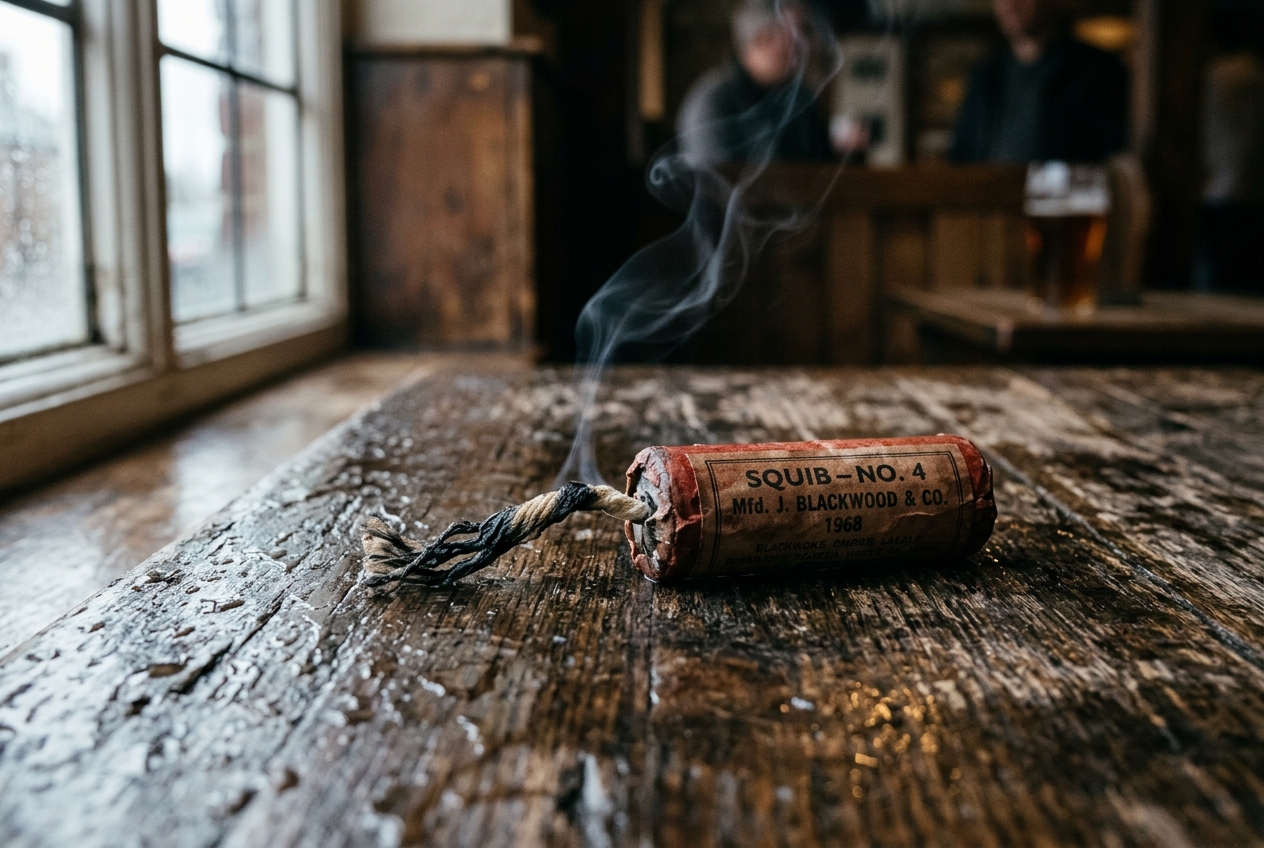
Anyway, back to the damp squib. A damp squib is one of my favourites, because many people think the phrase is a “damp squid”. Which is of course, ironic, because it turns out that since a squid is a sea creature, being damp would be the least of its problems.
Meanwhile, a damp squib refers to a cylindrical firework, and one that would be largely ineffective on account of it being damp. There’d be hissing and spluttering. But otherwise, a significant anti-climax. In March 1837, in the newspaper called The Morning Post, the phrase was used to refer to a politician’s weak performance. A “fizzling damp squib”. Quite brilliant when you think about it. A phrase that sits in the high order of expressions along with: “A fart in a colander”.
Moving on, the next expression that caught my eye recently, is: “On tenterhooks”. It’s another of those phrases we throw around without necessarily knowing where it came from.
A tenter was a large wooden frame used to stretch wet woollen cloth to prevent it from shrinking as it dried. Used in textile manufacturing way back in the 14th Century. The hook part comes from the sharp metal nails called tenterhooks that held the fabric tight under constant tension.
Now, the fun part. There are some folk who believe the expression is: “Tenderhooks”. Imagine, if you will, being on tenderhooks. “I’m feeling very calm and gentle while I defuse this explosive device where I don’t know whether to cut the green wire or the red one”.
After a considerable bang, it might be an opportune time to point out being on tenterhooks means “in impatient suspense”, and to realise it should have been the red wire.
So, the phrases are turning, while the squibs are damp and we are all on tenterhooks. Still, at least we are not hanging by a thread.